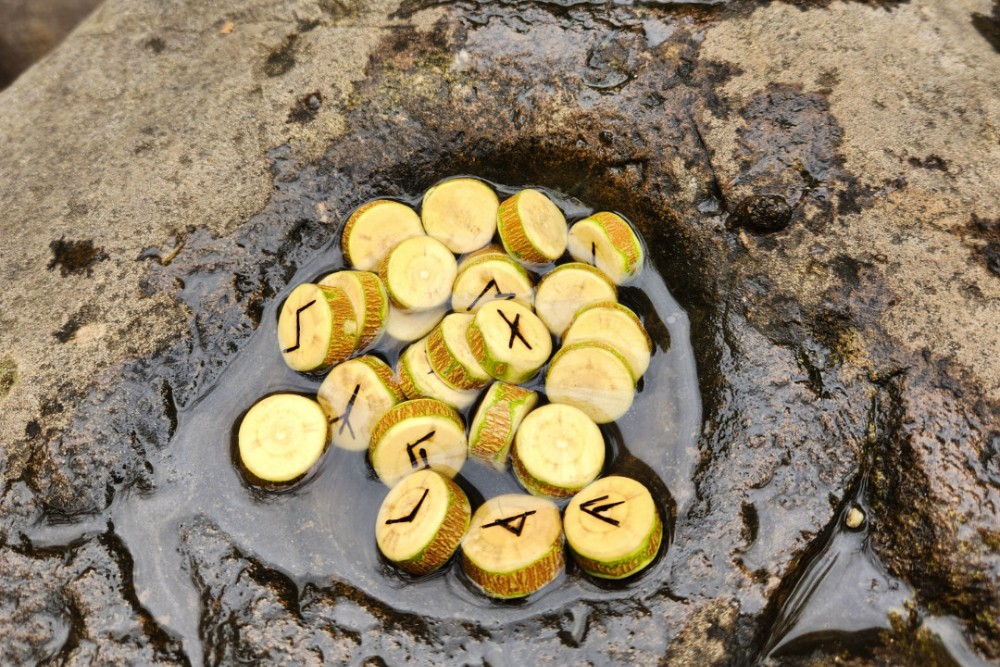
One can hardly talk about the runes of Old Norse without immediately getting mired in doubt and controversy.
The concept of “rune” is fundamentally tied to concepts of secrecy, whispering, and counsel. This is a theme that keeps coming up as we look at the historic practice of carving runes. But just as it’s useful to understand a god by studying their name, let’s first look at the linguistic origin of this word.
Scandinavian scholar and etymologist Anatoly Liberman believes the word “rune” derives from Germanic roots: “rūn-/raun-” meaning “to try; investigation.” The use of this word when talking about research and exploration necessarily predates the fuþark script, of course. Other researchers, like Richard L. Morris, believe it comes from an Indo-European root meaning “to scratch, to make grooves,” which speaks directly to the physical act of embedding the runes into an object rather than the weight of their meaning.
The word runa appears in the Gothic Bible as a translation for several Greek words: mystery, secret, plan, or counsel. In Old English, the word “rūn-“ slowly took shape as an archaic English verb, round, which at the time meant to whisper or talk in secret. In German, the cognate raunen means to whisper, even to present day. Already, we can see that the word rune is being applied in the contexts of important information, private information exclusive to a small group.
After the first fuþark was formed and being taught and spread among the Old Germanic tribes, the word runar (plural) was co-opted to describe this new alphabet as an ordered sequence of letters. The earliest known physical evidence of the word “rune” appears on the Einang stone in Norway, dating to 350–400 CE, in the phrase “runo faihido” or “painted the runes.” Note that the process of writing runes is almost always referred to as carving, until we get to the sagas and bindrunes can be printed or painted onto people.
Mythic Origin
The mythological origin of the runes, which are too old for me to call Elder Fuþark, are described in the poem Hávamál. We know the story: in a shamanic ritual, Óðinn hung himself from Yggdrasil for nine full nights, at which point he received the vision of the runes.
Why would he do this? If the runes had not existed, if they weren’t even a concept, why would he set out to create a ritual by which to attain them? What gave him the idea to do so?
Perhaps Óðinn didn’t know what he was getting into. It could be that the ritual was simply to catalyze his body into an ecstatic state, freeing his mind or soul to plunge into the depths where wisdom sleeps. Maybe he didn’t know what was waiting for him there, but he knew he wanted to explore, opening himself to whatever could be found. Or maybe he glimpsed the Norns carving fate as they shaped it, carving symbols into Yggdrasil’s trunk, carving wyrd into little wooden tiles. His urge wasn’t merely a boyish curiosity but a hunger to possess all wisdom and knowledge. We know in many other stories the sacrifices he committed to for exactly this: he had already given up one of his eyes as payment to sip at Mímir’s well and attain insight. It could be that what he learned there, and by observing the Norns, set him on this path.
The translations describe Óðinn as “hanging from” or “binding himself to” Yggdrasil. How can we picture this? He could have hung by his knees from a bough, commanding the discipline of his body to keep him in place for nine full nights. To bind himself to a tree, however, sounds like standing to lean against the trunk and tying his torso in place so he might slump in the ritual but never fall from contact with the tree. Perhaps he tied himself to the underside of a bough, or perhaps the Furious God of Death used a noose, one of his sacred symbols, to hang by the neck for the duration. The details may not be important, but we may like to imagine the process.
Yggdrasil itself is a liminal location, the World Tree. Óðinn is already in a location which is both nowhere, outside of the nine worlds, and the fundamental pillar of all reality. Here, he has chosen to sacrifice himself … but to whom? He is the All-Father, there is none above him. Who can he offer himself to? As he hung there for nine nights, depriving himself of food or drink, he took a spear (another of his sacred symbols) and sacrificed himself to himself. Hanging from the axis of the worlds, he mortified his own flesh, turned inward, and entered a state where his consciousness could begin the descent into hidden wisdom. Throughout the Old Norse myths we see gods and heroes who seek knowledge, favor, or powerful weapons, and these are never attained without great personal cost. It is a testament to what Óðinn hoped to receive, that he could put himself through such a trial.
In this state, he perceived the runes dimly glowing in the darkness, or they chose to reveal themselves to him. These were symbols that represented the fabric and operation of our own reality, runes of power for wyrd and galdr. Without knowing quite what he was looking at, but knowing this was what was intended for him, Óðinn released a deep and primal scream, the last push of his energy to drives his hands forward and collect the runes: not as objects he can hold in his hands, but thrusting his body into their very meaning, taking them into himself. They are inextricable from him now.
Utterly exhausted beyond endurance, his body returned him to Yggdrasil, and he is transformed. Not only did he heal as we would, he grew powerful and thrived. He contains the coding of the universe within him and the deep knowledge it carries. Now he can heal, he can bind his enemies, he has accessed incredible wisdom, not least the ability to interpret and shape fate.
After this, the runes are used for incredible acts that change the course of the world. In Rígsthula, Heimdall disguises himself as Rig to establish the Norse class system and grants runic knowledge exclusively to the noble class. In the Lay of Sigrdrífa, the valkyrie Sigrdrífa teaches vast runic lore to Sigurd, when he frees her from the stasis of her fiery armor, Óðinn’s punishment for her disobedience.
But because nothing great can ever be attained without something lost, some believe that the acquisition of the runes meant they were scraped out of a fundamental part of reality. Something in reality was subtracted, lessened by Óðinn’s taking them. And how much of their original power could possibly be retained as these were handed down, generation after generation, from the Æsir to the Vanir, to the elves, and finally to we humans?
Historic Origin
Obviously all we have is theory as to the runes’ origins. Nothing was written down prior to this, nothing could have been. We form theories, and we change them as new artifacts, new runestones are uncovered to tell us more of the story.
Liberman proposes that the runes were created around early first century CE. A hypothetical individual he calls the First Runemaster, someone native to Scandinavia, perhaps even a Dane, may have spent some time living in Rome as they were developing the pedagogical theory of elementa, the concept that letters could represent sounds and be strung together to form a cohesive series. This gave letters, naturally, the appearance of incredible power, as the arrangement of symbols could carry thoughts, ideas, messages and memories. Liberman further suggests that elementa was some teacher’s play on ailementa, or food, and that the First Runemaster was struck by the power of these letters to feed on themselves and create endlessly. Because of this generative trait, he chose the word “fuþ” for the first three letters of this new alphabet. Fuþ means vulva, as seen in Old Icelandic legislation: a fuðflogi, “vulva fleer,” was a man who attempted to abandon his bride before his wedding.
There is currently no reason to give any weight to the fact that “ark” means an effeminate coward. This is likely only a coincidence, and not a betrayal of the two words the First Runemaster heard most commonly in his travels.
Many alphabets around the world begin with an A-sound, but not fuþark. It was important to the First Runemaster that the whole sequence of letters be blessed with the life-giving power of fuþ. He intended to teach a dozen disciples his new alphabet and have them spread it throughout the Old Germanic tribes, so they could record their stories and trade information. To help memorize these, each rune got a mnemonic, a device using vivid imagery to remind people what the letter sounded like. Unfortunately, the tribes believed the runes were magic and did not preserve their stories but used them to bless their weapons and farm implements and love-charms instead, so we wouldn’t learn anything about these people until the colonization by the Christian scholars. This aside, “fuþark” is a stable arrangement that withstood evolution and development, so certainly the arrangement of these first six letters is not an accident.
Carving My Own Runes
As I moved into studying Old Norse and Scandinavian myth, I thought I should also take up the runes. A few minutes of shopping around online convinced me, instead, to try to make my own. That should be more meaningful, I thought. However, this was made more difficult by the fact that I don’t own any woodworking tools and didn’t want to buy things that I might only use once and would have no space to store, the rest of the time. I was able to borrow a handsaw from a neighbor, and I did end up purchasing a woodburning kit, which I don’t mind owning.
But how to go about creating, ritually, my own set of runes? What were the rules?
As you might imagine, five New Agers have eight opinions on how to officially create authentic runes. There are dozens of websites out there, each claiming they know the true path, none of them agreeing with each other. Worse, an increasing percentage of them are created by AI generators, proof-of-concept sites that quickly collect and process (and corrupt) information. Who was I really reading, when I did my research?
Well, like an LLM, I took in a lot of information and crystalized it to a few points of commonality. After that, I could only trust my own intuition to try to find the “right” answer, or the answers that were right for me.
As heathen Scandinavian society estimated their months by the new moons, I interpreted the full moons to be the peak of power, if any was to be had. As for the material of the runes, I didn’t have a Dremel to carve into stone or metal. I know that wolf bone and deer antler are popular and exciting choices, but I didn’t have easy access to these, and I didn’t particularly feel an affinity to either. I thought wood would be an honest, simple beginning. If later revelations bound me to an animal, that venue could be explored at another time.
What kind of wood, though? Yew was mentioned, but I believe it’s poisonous. Ash, I had no access to. A few sources suggested that the wood of a fruit-bearing tree in particular was called for. I asked around and a friend indicated that he had a mulberry tree that was bothering him and he was about to chop it all down, if I wanted a piece. I woke up early on Sept. 17, 2024, at the peak of the Harvest Moon, drove to my friend’s house, and I identified a length of bough that suited my needs, enough for 24 discs plus several to make mistakes with. With a prayer of thanks to the tree, I harvested the bough and gave it my offering—a filterless, hand-rolled clove cigarette from the Sampoerna factory in Jakarta. I only have a few of these left, and the sacrifice was significant to me. Regardless, my friend tore the rest of the tree down after I left.
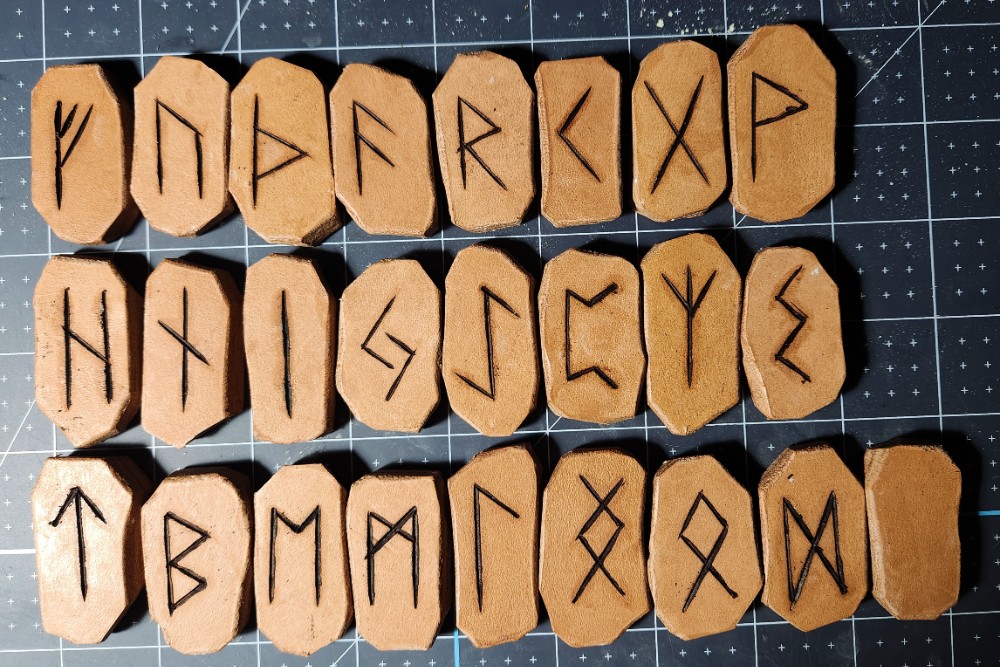
As it happened, as I talked about creating these runes with family, my brother-in-law offered to make me some tiles. He’s a leatherworker who sells clothing and bags, and it would be simple enough for him to knock this out. He even furnished a lovely pouch to contain them. So I’d make two sets of runes, a sacred mulberry set and leather for backup.
Most sites agreed that the bough needed a month to dry out properly, and some suggested this was a good time to pray over the bough with intention, letting it know what it would be used for, gathering energy to put into the wood. I found a lot of pleasure in setting up a small altar and kneeling before it, each night, grounding myself and guiding whatever energy my undeveloped skills could to the bough. I didn’t know what I was doing with the altar, either: my notions come from half-remembered Gardnerian Wicca. But I set something up, and that gave it meaning, and I felt some amount of energy and peace as I performed the ritual every night.
I had to wonder: was it disrespectful to appropriate Native American names for the full moons, when performing a heathen Scandinavian ritual? I mean, they didn’t have names for their full moons: they started each month with the new moon—Mörsugur, Þorri, Góa, &c.—so all I could say was “the full moon during Haustmánuðr.” But I’m not treating the Native American names as universal or interchangeable. I fully acknowledge where they came from (and that different tribes at their own names for them). It’s simply a marker of time while working within another heathen system. My usage comes from a place of respect, taking nothing for granted.
Before the Hunter’s Moon, I sawed the bough up into little disks, then sanded these down progressively with 150-, 220-, and 400-grit sandpaper, until they became nearly glassy-smooth on one side. I gave the rune-side rounded edges, and at this point they began to resemble antler. My friends remarked on this later.
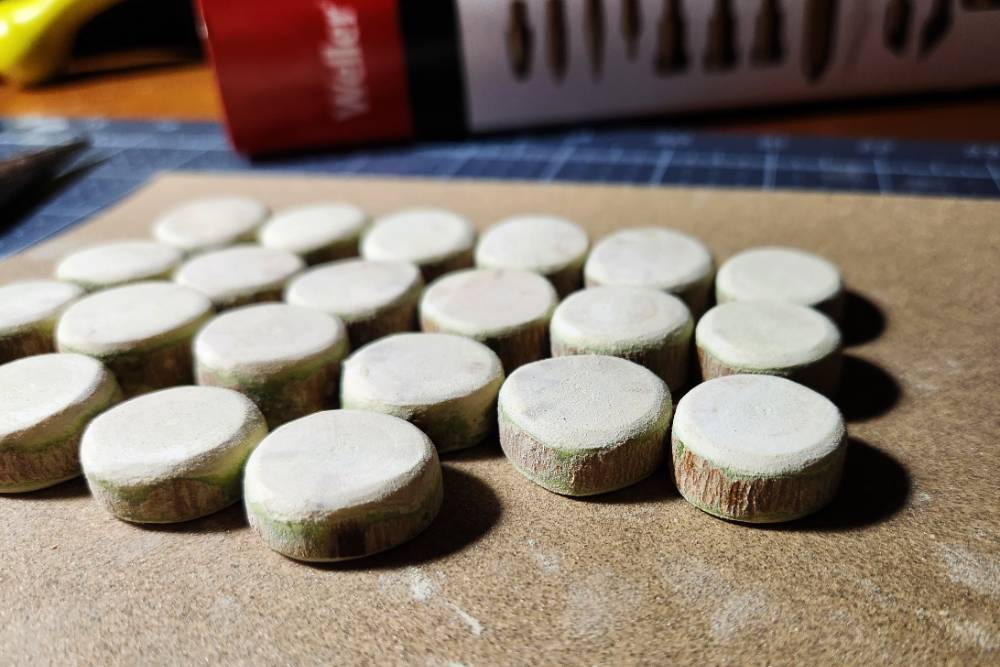
Late, late at night on October 17, I ran an extension cord out of my apartment window and down to the front yard, where I set up a small chair and folding table with a lantern. I spread out the mulberry disks and the leather tiles, and I brought a book that explained the meanings of the runes. With the full moon shining upon me, I carved each rune into the disks, reciting its name and its meaning as I touched it up.
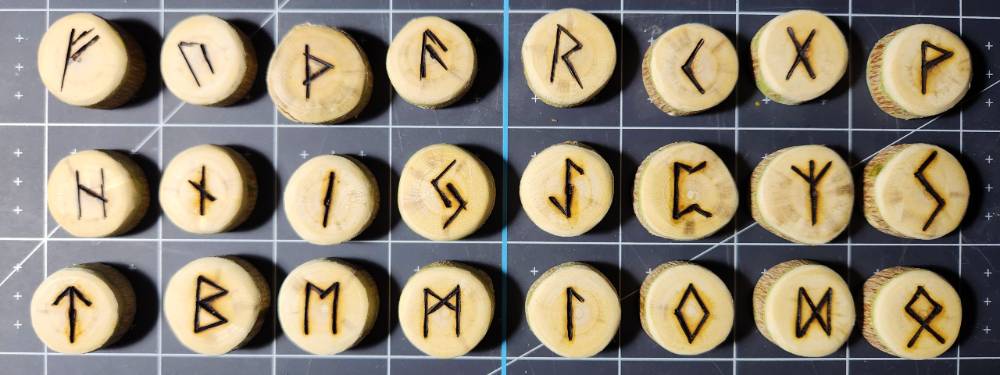
The leather ones went quickly: I’d read that you have to move quickly with those, because you’re burning into flesh, and you should have a metal scrub pad on hand to clean the nib of your pyrographic pen occasionally. I’d also read that you should be able to hold the full set of runes in one hand, and each of these sets met that requirement. Due to my studies of pre-Old Norse giantess cults in heathen Scandinavia, I went with Elder Fuþark for both sets of runes, though the leather runes bear later variations of some of the characters, seen in Sowilo and Inguz.
I was very happy with how they came out. They looked great, to my eyes, and the ritual wasn’t even done. The next night I brought them down to the Giantess’s Glade, to the natural stone bowl where I consecrated them in water, earth, air, and fire. (Like I said, I didn’t know what I was doing, but it meant something heavy to me at the time.) The leather runes were fine as they were, but I rubbed beeswax and jojoba oil into the mulberry runes to help keep them nice. Every once in a while I bring them back to the Glade to charge them up again. They work well with readings, where I simply look at my present situation from another perspective. These are never used for fortune-telling or predicting the future, only for helping me understand and accept my wyrd.
 Aborigen
Leave a comment