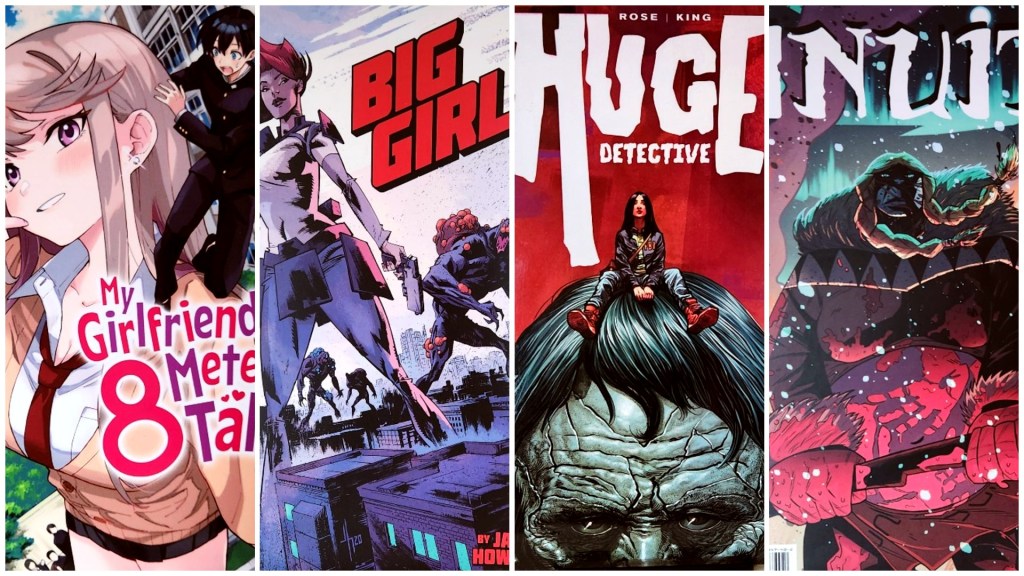
One day I was wandering without purpose through a part of town I rarely visit. I spotted a comic book store and decided to poke around. I found a copy of Huge Detective and Inuit #1 and got curious as to whether there were any other Size-adjacent comics out there. I found a few and picked them up.
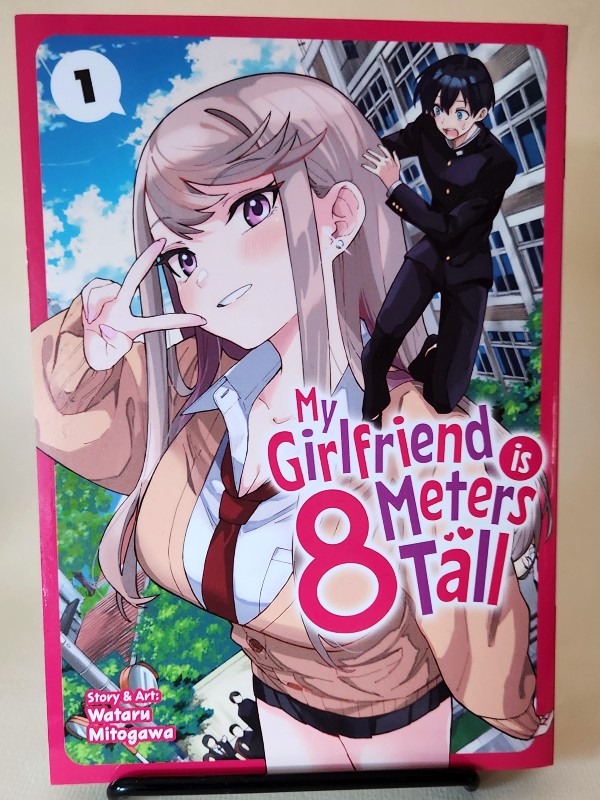
My Girlfriend is 8 Meters Tall
High schooler Yumeji is reunited with his childhood friend, Chieri, now a giantess.
Banality ensues.
I was really excited about this one, immediately identifying with the tiny boyfriend, Yumeji. However, he did none of the things I would do, so this was only an exercise in frustration. Look: He’s got a gigantic, beautiful woman who’s interested in him, devoted to him, and all he can do is fret about what the other classmates might think. So he’s afraid of being branded heterosexual? Is he seriously reserving space for someone better to come along? The fuck?
The story rarely explores scale in a meaningful way. Chieri, the giantess, is issued oversized supplies and even living quarters by a company dedicated to serve her, and only her. There was one opportunity for Yumeji to feel small in her dorm, but not much was done with that. All the chapters in the book I have are repetitive, with romantic near-misses, each character struggling to suppress how they feel, hints of truth coming out anyway, and then Yumeji bearing the brunt of an awkward giantess for comedic effect. How about one chapter of that, they get together, and then the rest of the series can explore broader implications like society struggling to accept a mixed-size couple? The cultural implications of gender power dynamics flipped? The vulnerability of a powerful being, the unexpected strength of a tiny man? There were so many interesting topics in which to break ground, but every single chapter was just childish awkwardness and comedy of errors.
There was one tender moment that I thought was well done. Because they were childhood friends, Yumeji and Chieri retained some of their emotional structure. There was a point where Chieri needed to be comforted by him, size regardless, and his familiar touch was powerful enough to mean something to her. That was a rare and exceptional moment in an otherwise trite, stereotypical narrative.
If you’ve never read manga or watched anime before, this story will be great for you. Everything will seem fresh and new, you’ll be titillated by the endless “OMG, they almost kissed,” boob jokes, and upskirt shots. Otherwise, the entire story looks like the panels could’ve been clipped directly out of a dozen other titles.
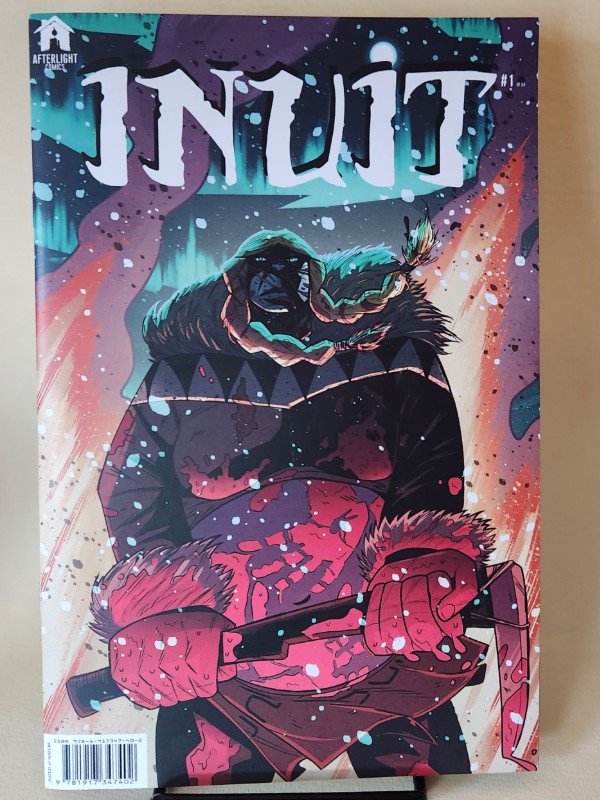
Inuit
Gritty, stylized artwork telling a familiar tale of a power-hungry tormentor who will slaughter everyone between him and a magical item, and the indigenous people who suffer for his ambition.
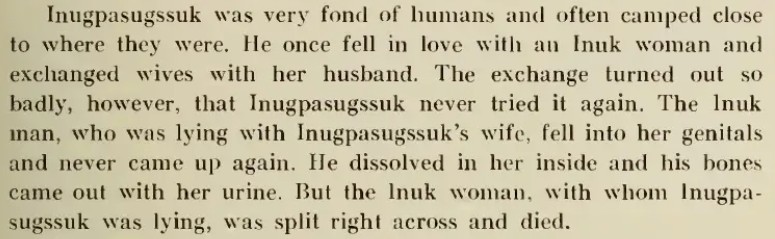
There’s so much wrong with this one. The series is called Inuit, but the main characters—a reclusive clan of giants—look Scottish or Norse with their red hair and long braids. The story claims the giants were known as Kiviuq, but more commonly the Inuits. Kiviuq was a legendary Inuit folk hero, while Inugpasugssuk was actually a giant (inukpasugjuk or inukpait mean “giant (people)”). He’s not to be confused with Inukpasarjuk, “the giantess that married an Inuit man.”
What was interesting about this story is the main character, a woman warrior who’s isolated from her tribe and has to cope with her impending pregnancy against a hostile environment. That is something I haven’t seen before, a pregnant giantess, both powerful and vulnerable in a meaningful way. I might browse #2 to see how it handles the actual story, but otherwise, the exaggerated and inconsistent facial expressions, endless screaming and gratuitous violence didn’t compel me. Neither did the antagonist, Wood-Face, who I’m betting turns out to be some white invader exploiting local people and resources in his quest for power. He’s wearing a mask, but it’s pretty obvious where this is going.
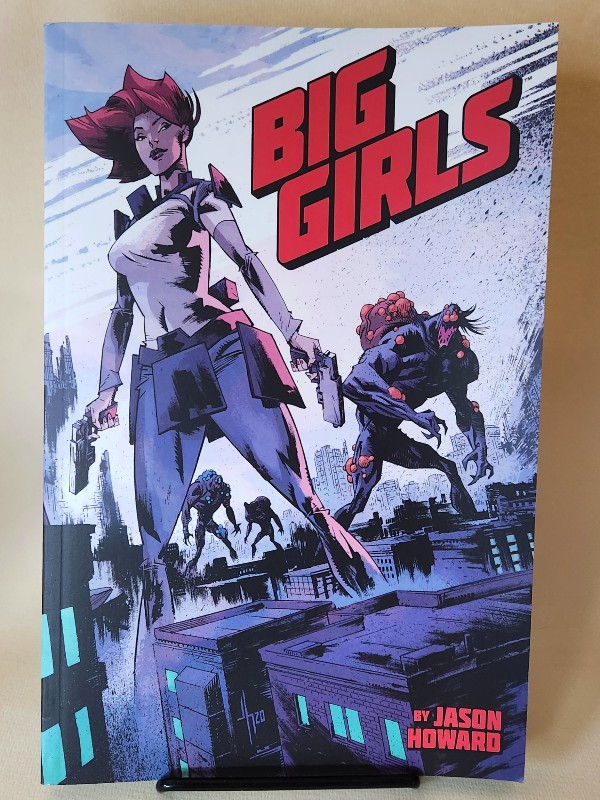
Big Girls
Gigantic women, grown large, somehow immune to the virus that turns male giants monstrous. A little too on the nose.
The artwork gets worse. It’s heavily stylized, and both reasonable anatomical structure and facial expressions suffer for it. This does even less with scale: once the chosen women are enlarged to defend their portion of the city, they simply enter another world. Normal-sized people move through normal-sized settings and watch the giants fight. Giant women wade through featureless buildings and attack gigantic mutated people where they appear. There’s very little mixed-size interaction. Sure, there’s a scene where Ember’s stretched out in a warehouse while little men pull incomprehensible maintenance on random spots of her body. But she doesn’t even look big there, nothing about her screams “massive.” If anything, the crew look like dolls.
The script is erratic as well. Basic grammatical errors and unstable shifts in tone took me out of the story. At one point during an action sequence, Ember tells Apex, “Guess we save that hug for later?” What hug? No one mentioned a hug. They were literally in the middle of shooting down monsters, after shoving fallen buildings upright (???). It reads like no one gave this a substantive read-through.
All that, to weed your way through vague messages hinting at eugenics, gender politics, social control and “sudden yet inevitable betrayal,” with contorted facial expressions and ergonomically improbable melee sequences, all of which wraps up tidily in a rush. In this story, what’s the difference between a 300′-tall woman and Superman? Growing big is nothing more than a superhero power level, an adventure on a parallel dimension.
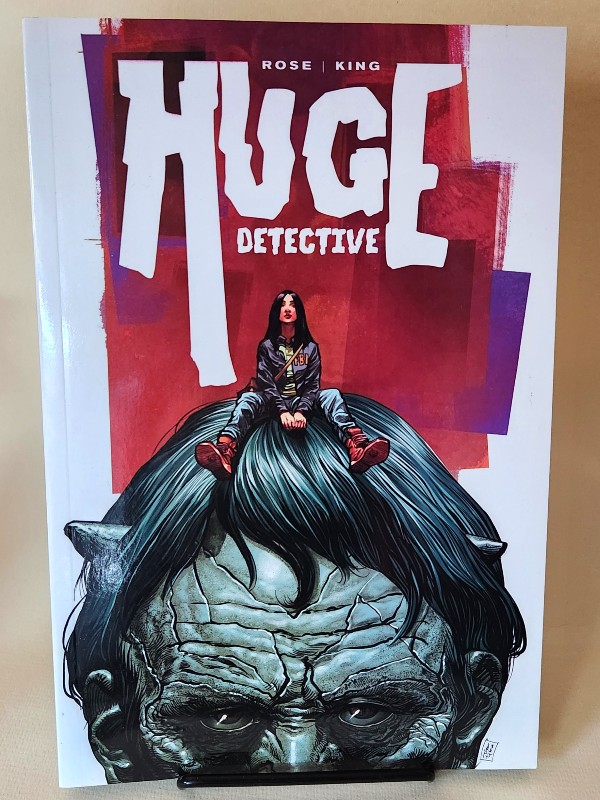
Huge Detective
From a sovereign nation of giants, one man teams with a normal-sized detective to uncover an increasingly bizarre conspiracy.
This story does a lot of worldbuilding within scale, and that’s interesting. It focuses on the world of giants and the world of regular people, from slang terms to infrastructure. It doesn’t fall back on “wouldn’t it be weird if …” and instead treats mixed-scale seriously.
What I didn’t care for was the strange dance between quite a lot of conspiracies and a discordant fairy-tale overture. If it had stuck with hardboiled detective noir, with an unusual premise, that would’ve been great. If it had focused on culture clash and social disruption, that would have been interesting. The puns (the main character’s name is Gyant) and the fanciful dressing seemed to compromise the integrity of the story.
The artwork looked great when I glanced at it in the store, but when I sat down and read through it, it was disappointing. Characters make gestures and take stances that make no sense in the scene. The illustrations had high aspirations, and I don’t blame them for making the attempt, but sometimes it falls flat and hurts the story. For that matter, and again, the writing is erratic and unsteady, so it feels like the writer had a clear storyline in his mind but didn’t double-check to see whether it translated on the page.
The whole “possibly insane man with unusual powers” gimmick felt borrowed. I did like the body dysmorphia aspect, but the rest of it just felt like I’d seen it elsewhere. I hate it when someone’s like “I loved this in another story, I can pull it off in mine” when that’s exactly what it feels like.
All four of these graphic novels launched with the understanding that giant people are visually interesting. I can get behind that, and gods know I wanted to support it. None of them seemed to understand, consistently, how scale alters relationships, perspective, intimacy, logistics, etc. Some did, some touched on these, but it wasn’t intrinsic enough to the story, and its omission was glaring. Perhaps that’s too “inside baseball” as I consume these stories from deep within Size Fantasy, and for the general consumer these will be novel, enticing works that dazzle the imagination.

 Aborigen
Leave a comment